Recommendations
The 5 Bridges Options Study answers four questions:
- Can existing Gateshead provision adequately replace the closed facility?
- If not, which new-site options are viable?
- How should delivery be approached?
- What does the evidence point to?
Sections 2–6 set out the answers to the first three. This section sets out the fourth.
The recommendation that follows is built on the survey evidence in § 2 (134 responses, unusually consistent across all six measures), the policy alignment in § 1.3 (four locally-adopted documents and one national strategy), the existing-parks finding in § 3.6, the new-site assessment in § 4, the comparative options in § 5, and the precedent evidence in Appendix F.
The recommendation below is the Phase 1 finding, built on the evidence gathered through eight weeks of work to date: 134 survey responses, full policy alignment, assessment of all nine Gateshead skateparks, site visits to Askew Road and Gateshead Stadium (May 2026), eighteen UK and international precedent profiles, and the comparative work in § 5 and § 6.
A defined set of Phase 2 inputs remains outstanding — supplier design returns, contractor quotes for the council finance section, planning pre-applications, the nine existing-parks site visits, candidate car park identification, and follow-up engagement on demographic gaps. All are listed in Outstanding Evidence — Phase 2 Inputs on the report landing page. None, on the evidence to hand, is expected to overturn the Phase 1 finding; each is a confirmation or refinement step. The alternative-recommendation triggers in § 7.2 give the council an evidence-based pivot route if any Phase 2 input materially changes the comparative picture. Phase 2 is not work already under way: it would proceed only if the council decides to progress the project and expressly commissions the next stage (with Shred The North or another delivery partner).
7.1 Primary Recommendation
Gateshead Council should proceed with development of a phased replacement skatepark at Askew Road, with Phase 1 delivering ground preparation, the higher-coverage option (60–80% of the 842 m² plot), and relocated 5 Bridges equipment, alongside fit-out of two of the seven adjacent railway arches (toilets / amenities and storage / maintenance), subject to an early Network Rail use-agreement.
Phase 1 target opening: within 12 months of council approval to proceed, contingent on planning approval and procurement timing. Supplier concept design is already in — Betongpark delivered the Askew Road concept on 16 May 2026 (see § 6.1.3). The 12-month horizon sits within the 58% majority the survey identified as wanting delivery within 12 months.
The site, in pictures
Seven photo and design-concept slots illustrate the Askew Road site and its supporting infrastructure. The supplier design concept slot is populated with Betongpark's entrance-view render (16 May 2026); the remaining slots draw on photos from the May 2026 site visit and populate as they are processed.
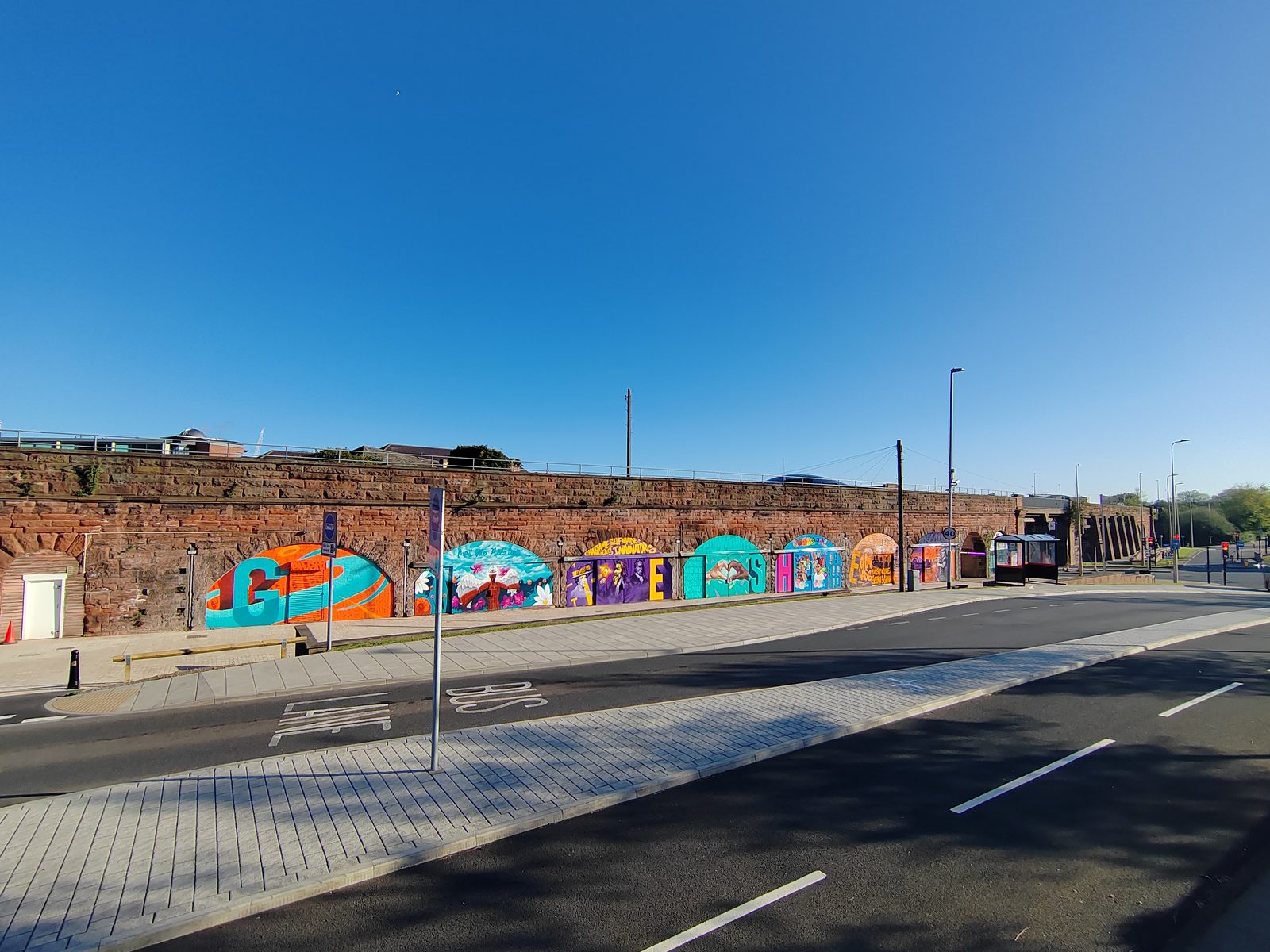
Site overview — the full arches run in its urban setting. April 2026.
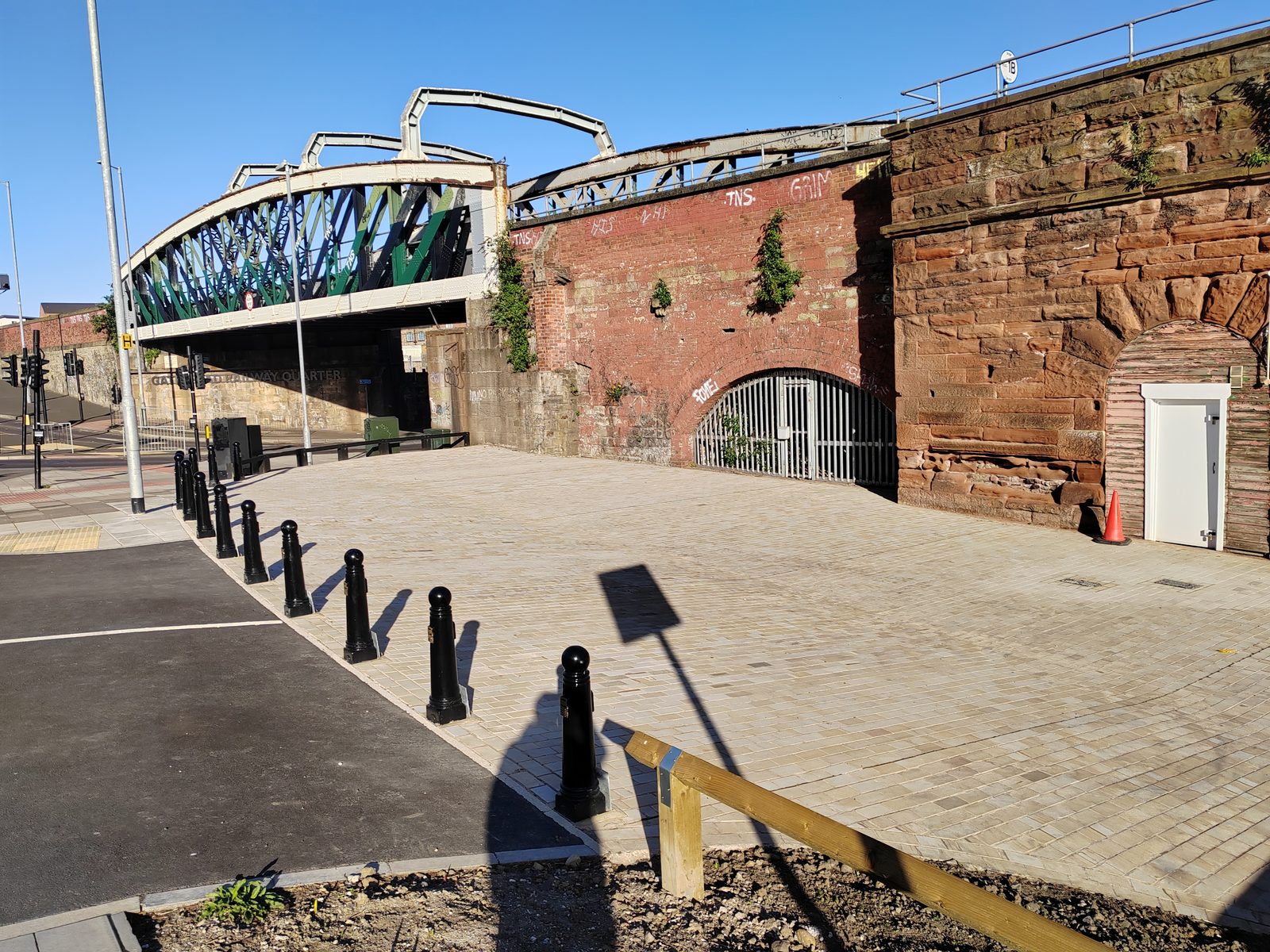
The ~842 m² plot — ground-level view of the skatepark site at the west end. April 2026.
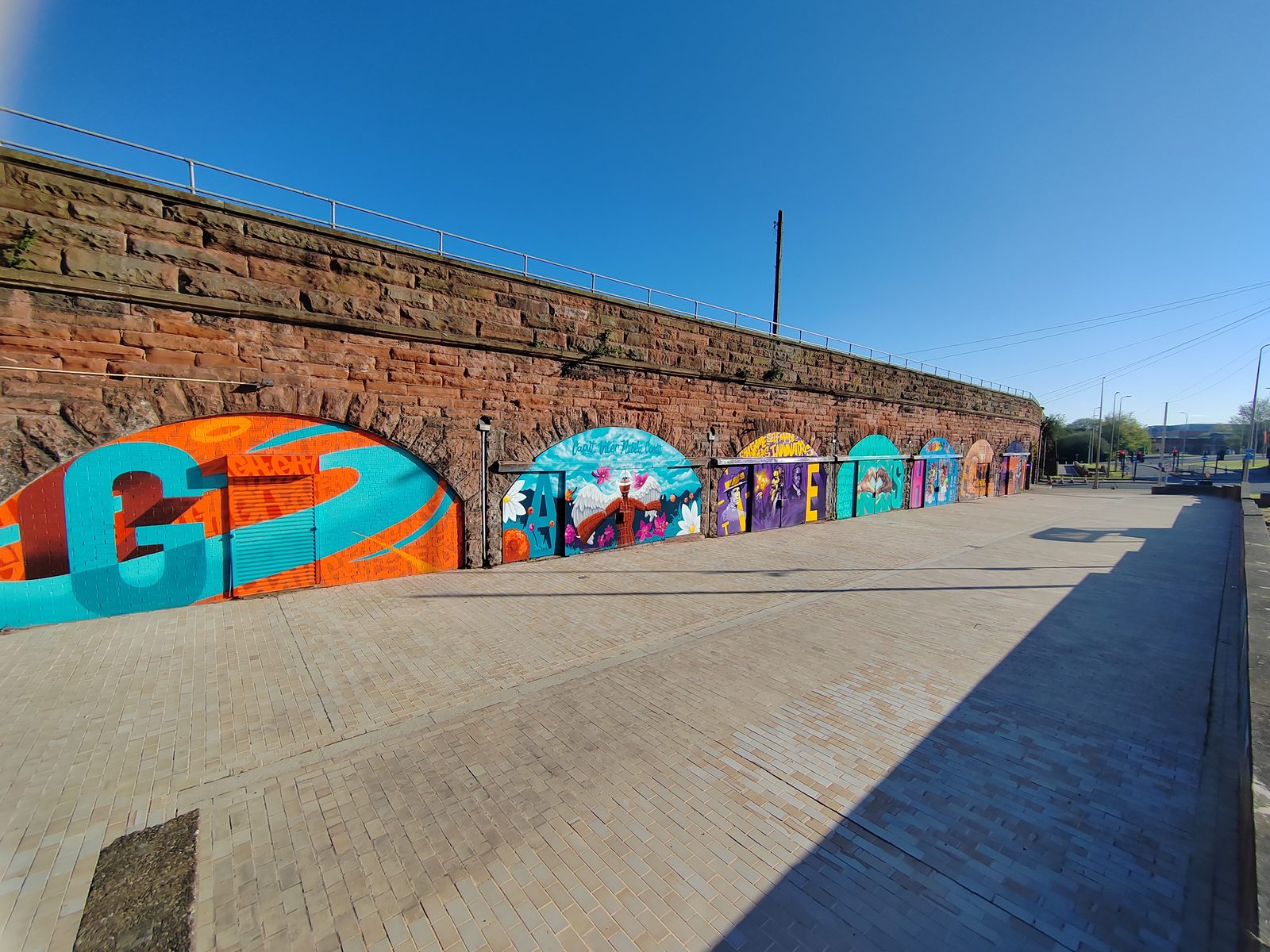
The seven railway arches — front-on view alongside the plot. April 2026.
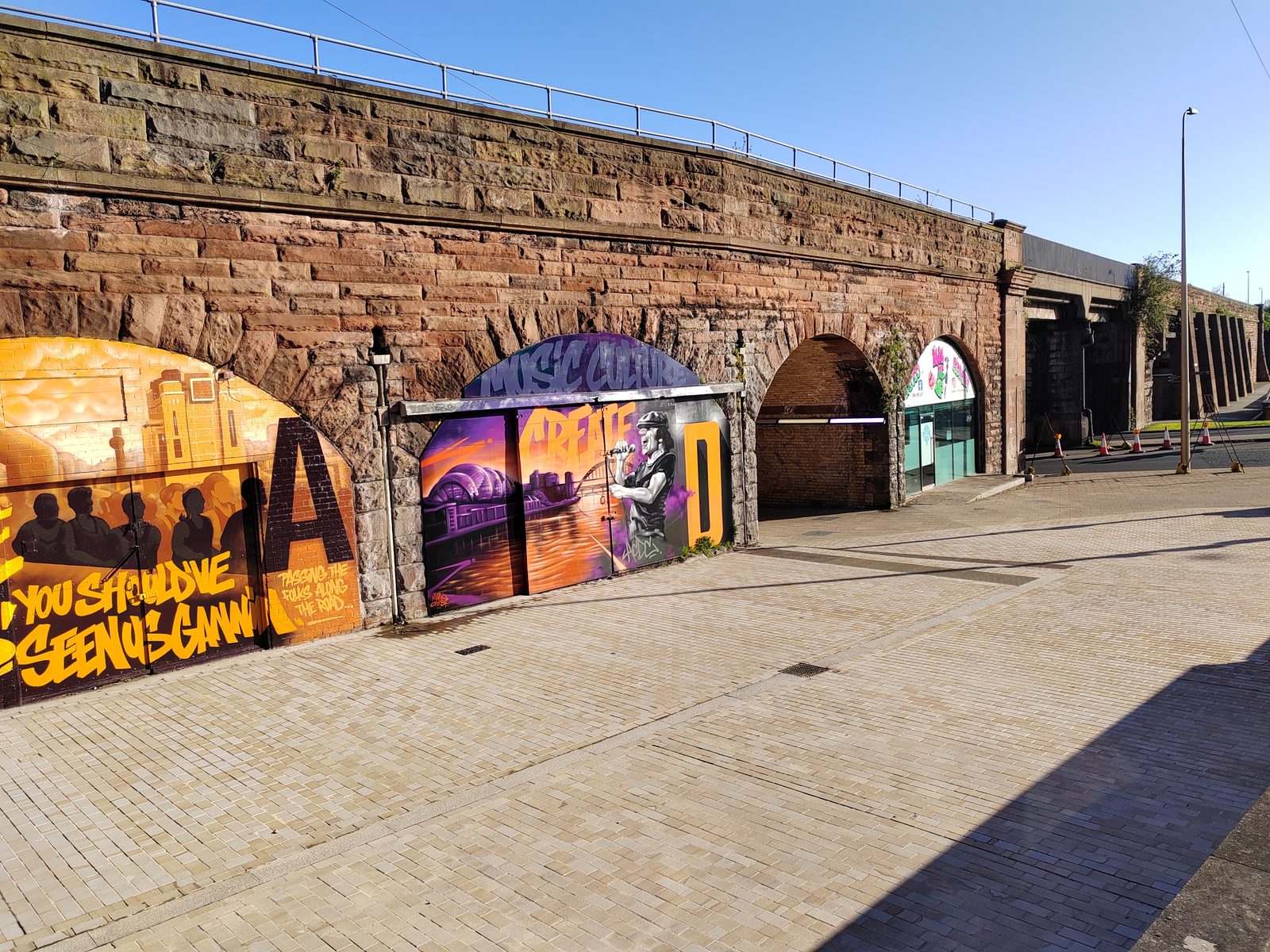
East end — the through-arch and mural detail. April 2026.
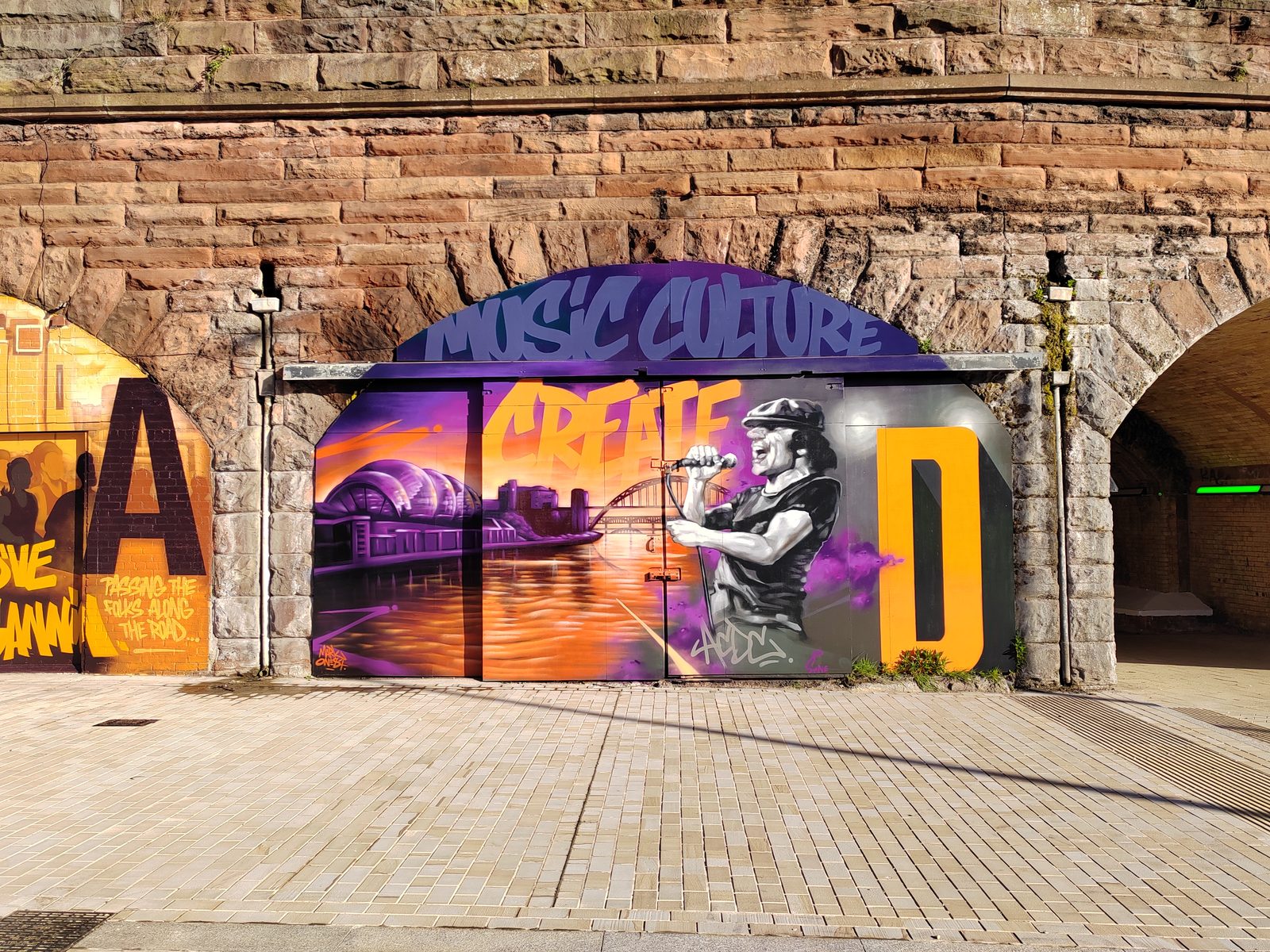
Arch detail — ‘Music Culture Create’ mural showing arch scale and character. April 2026.
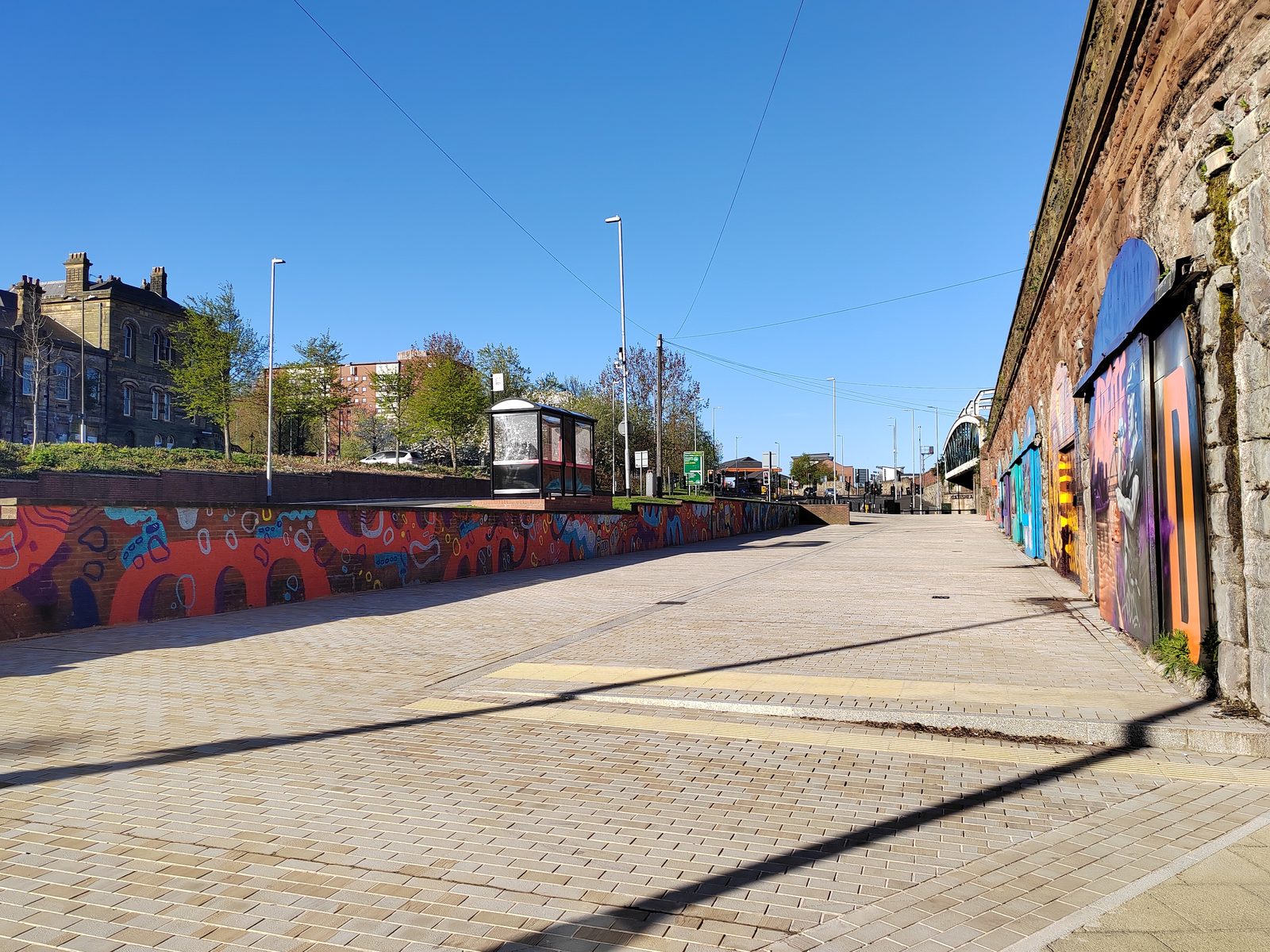
Context — surrounding land use, transport access, and residential area above. April 2026.
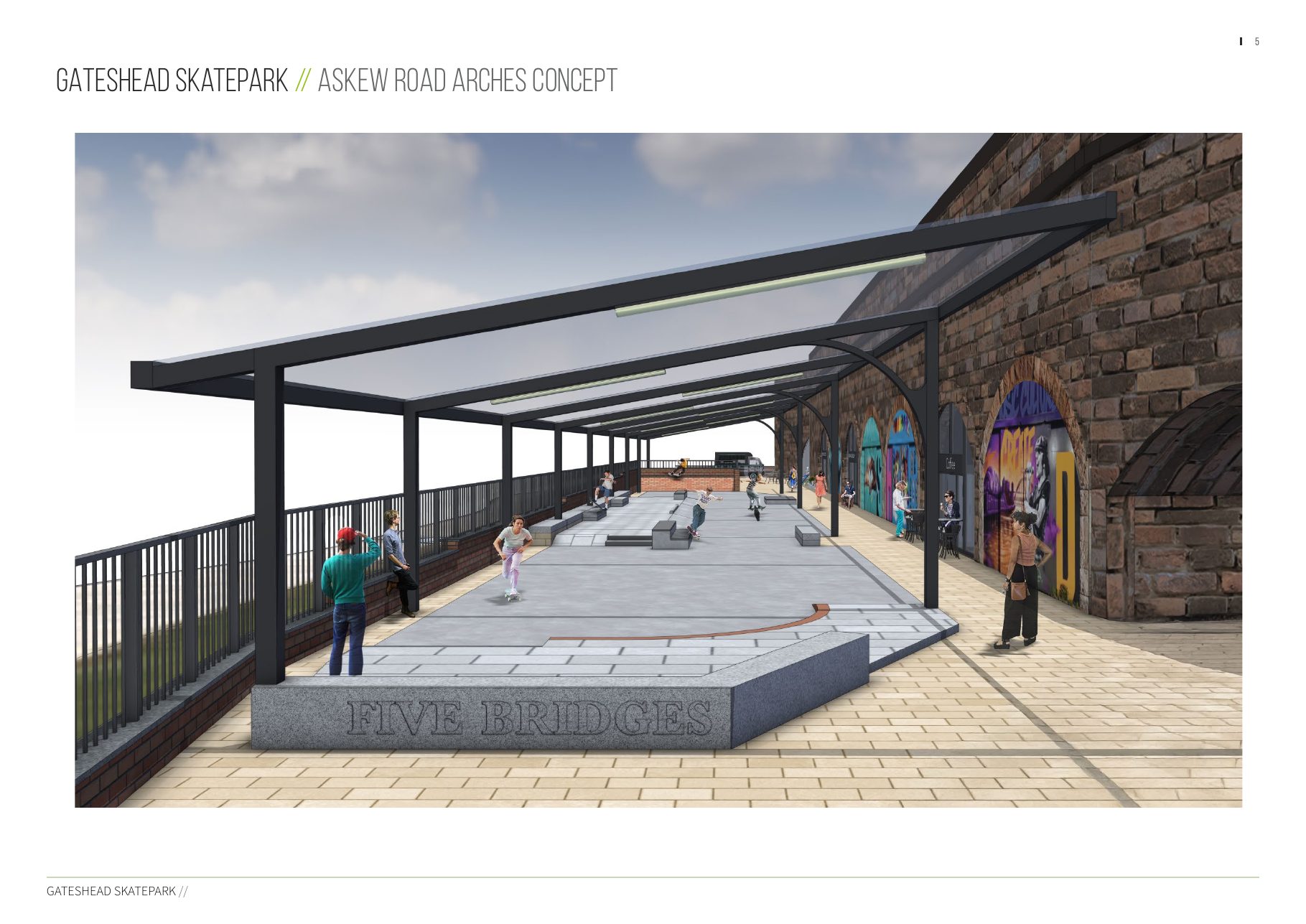
Gallery 7.1a — The Askew Road site and its seven adjacent railway arches. Photos from the May 2026 site visit; concept render from Betongpark (16 May 2026, see § 6.1.3).
Why Askew Road
Across the comparative framework, Askew Road meets the most of the community-priority requirements and unlocks the most of the supporting infrastructure case at a deliverable scale:
- It is the most central of the three shortlisted sites. Survey respondents value central provision but do not require it (town-centre proximity ranks last of ten replacement priorities, with 95% willing to travel further for higher quality). Askew Road delivers centrality without sacrificing quality.
- It supports the highest achievable coverage percentage of the three at the smallest footprint. 60–80% coverage is financially realistic at 842 m² in a way that full coverage of Stadium's 4,883 m² is not. This directly meets the community's number-one replacement priority.
- The seven adjacent railway arches — not deep enough to skate inside, but available for storage and supporting services — can provide café, toilets / amenities, skate shop, coaching / workshop, community / events, storage / maintenance, and a heritage gallery in dedicated, controllable space, phased over Phase 1–3 and subject to a use-agreement with their owner, Network Rail. No other shortlisted site offers a comparable infrastructure pack at the same scale or deliverability.
- Phase 1 will feel complete on day one rather than sparse, because equipment density at 842 m² reproduces the plaza-feel that survey respondents identified as what made 5 Bridges special. This addresses the "Phase 1 must include cover and quality surface" condition in the survey's 80% phased-delivery mandate.
- The closest precedent set is the strongest. BaySixty6 (London, 28 years), Projekts MCR (Manchester, 21 years), Friedensbrücke (Frankfurt, current 2024 municipal investment), The House Sheffield (skater-owned governance), and Spit & Sawdust (Cardiff, CIC + ancillary revenue) all map directly onto components of the Askew Road approach. See Appendix F.
Phase 1 scope
- Smooth, skatepark-quality concrete base across the 842 m² plot.
- Purpose-built covering — tensile / canopy structure — over approximately 60–80% of the plot.
- Relocated 5 Bridges equipment in a dense plaza layout — the original obstacles are in council storage in good condition and suitable for direct reuse (see § 3, item 9).
- Fit-out of Arch 2 (toilets / amenities) and Arch 6 (storage / maintenance) with shared utilities, subject to an early Network Rail use-agreement for those two arches.
- Public-realm interface: fencing, signage, lighting, seating, basic landscaping.
- Phase 2 (Years 1–2): Arches 1 (café) and 3 (skate shop) activated; covering extension if not already at 80%; equipment refresh.
- Phase 3 (Years 2–5): Arches 4 (coaching), 5 (community / events), 7 (heritage gallery); enhanced lighting and public realm.
The full Phase 1 / 2 / 3 scope is set out in § 6.1. The Askew Road Phase 1 / 2 / 3 cost envelope, funding stack, and revenue projections are in § F Finance.
Caveats on the primary recommendation
Ownership of the Askew Road site is resolved in the scheme's favour: the skatepark plot is council-owned, and the free-standing canopy is designed so the skatepark structure does not rely on Network Rail. Phase 1 also fits out two of the Network Rail-owned arches (Arch 2 toilets, Arch 6 storage), which depends on securing an early use-agreement with Network Rail — the scheme's one Network Rail dependency, and a use-agreement rather than a structural one; the remaining arches are an optional later-phase upside. That leaves a single material unknown on the Askew Road case at the time of this Phase 1 report:
- Detailed ground, noise, and drainage assessment. The site was visited in May 2026 and the assessment is now backed by direct observation; a formal ground / noise / drainage assessment would follow in a Phase 2, if the council progresses the project, to firm up the build envelope (against Betongpark's concept specification) and the residential- neighbour noise management.
This unknown is bounded and time-boxed. It is not a structural objection to the recommendation; it is the kind of confirmation step any major capital recommendation requires before commitment.
7.2 Alternative Recommendations
Stadium and the Car Park Conversion approach are positioned as evidence-ready alternatives, not also-rans. Each is good at something Askew Road is not, and each becomes the recommended option under specific conditions. The full case for each is set out in their respective § 6 entries.
7.2.1 Gateshead Stadium — the scale-and-deliverability alternative
Conditions under which Stadium becomes the recommended option:
- Askew Road planning encounters a substantive constraint not yet identified.
- Site visit reveals ground or residential-neighbour issues that materially change the cost or risk profile.
- Council determines the multi-discipline / sports-hub integration argument (see Graystone and StreetDome in Appendix F) is the strategically preferred direction.
Under any of these conditions, Stadium delivers the largest footprint of the three, full council ownership, the lowest deliverability risk, and the strongest co-location upside. The trade-off is partial covering (40–50%) on a sparser Phase 1, which the survey evidence flags as the core constraint relative to a more central, more-covered site.
7.2.2 Car Park Conversion — the covering-and-character alternative
This approach is building-agnostic: it applies to any qualifying sheltered, multi-storey car park the council chooses. A Quays-area building is used as the illustrative example throughout — partly because it would double as a town-centre / Quays regeneration anchor — but the conversion model is not tied to the Quays or to any one building.
Conditions under which the Car Park Conversion approach becomes the recommended option:
- The council identifies a specific candidate building with structural sign-off and acceptable terms (and, where the building falls in the Quays area, masterplan compatibility) within the study horizon.
- The chosen building lends itself to being framed as a town-centre or Quays regeneration anchor (e.g. CSUCP QB2 leisure use, town-centre activation), with funding routes that follow that framing.
- Askew Road planning has not resolved AND the structural survey on the chosen car park returns favourably within the study window.
Under those conditions, a covered car park delivers 100% covering on enclosed levels at zero new-build covering cost — a unique offering across the three. The trade-off is the ceiling-height constraint on transition features and the prerequisite of council site identification, neither of which can be resolved before the building is chosen.
7.3 Recommendation Rationale
The primary recommendation is anchored in five separable evidence bases. Each is independently sufficient to reject "do nothing" and the existing-parks-only options; together they point to Askew Road as the lead because it best meets the conjunction of community priority, policy fit, deliverability, and precedent.
1. Community evidence (§ 2)
The survey's findings are unusually consistent across six measures. Cover is the non-negotiable, town-centre proximity is permitted but not required, existing parks do not absorb 5 Bridges users, phased delivery has a clear public mandate provided Phase 1 includes cover and quality surface, equipment reuse has 85% support, and time pressure is real but bounded. The Askew Road approach satisfies all six. The Stadium approach satisfies five (cover is partial); the Car Park Conversion approach satisfies all six but depends on a specific building being identified.
2. Policy alignment (§ 1.3)
Five locally-adopted policies and one national strategy line up directly behind a covered, free-at-point-of-use, all-ages skatepark in or near the urban core. CSUCP CS14, CS15, CS8, MSGP 39, MSGP 40, the Quays Development Framework (QB2), the Physical Activity Strategy 2022–2032, the Children & Young People's Partnership Strategy 2025–2030, and Sport England's Uniting the Movement all anticipate this kind of provision. The recommendation is asking the council to deliver against direction it has already set, against a recreational gap its own protective policy (MSGP 39) says should not stand. None of the three shortlisted sites contradicts any of the policies cited; Askew Road's centrality alignment with CS8 (focusing leisure / culture / tourism in the urban core) and CYP Strategy ("safer inclusive social and green spaces") gives it the strongest policy-fit reading of the three.
3. Existing-parks evidence (§ 3)
The assessment of the nine Gateshead parks confirms the community evidence: none has covered provision, none is town-centre located, all are dominated by transition rather than plaza terrain. Enhancement of the existing park with the greatest replacement potential (Dunston) is a useful longer-term adjunct but does not replace 5 Bridges. New-site provision is the policy-anticipated route.
4. Precedent evidence (Appendix F)
Eighteen profiles inform the case (eight deep, ten tail-list). Headline cost spread is £650/m² (StreetDome) → ~£780/m² (Lynch Family) → £5,230/m² (F51). The covered + reused-civic-infrastructure model that Askew Road approximates (purpose-built canopy + adjacent reused arches) is durable across decades (BaySixty6 28 years, Projekts MCR 21 years, Dean Lane 47 years), is current municipal policy in comparable jurisdictions (Friedensbrücke Frankfurt 2024), and supports the CIC + ancillary-revenue operating model (Spit & Sawdust Cardiff, Bryggeriet Malmö) that Shred The North would run.
5. Deliverability
On a 12-month Phase 1 horizon, Askew Road's smaller footprint, lower ground-prep volume, and council-led planning route are all deliverable advantages. Supplier concept design is in for the Askew Road site specifically — Betongpark delivered the concept on 16 May 2026 (see § 6.1.3); equivalent supplier work for the Car Park Conversion is dependent on building selection, and has not been commissioned for Stadium within the interim study window. The remaining unknowns are time-boxed. The financial picture (§ F) is consistent with this reading; Phase 2 contractor quotes will firm up the bracketed Phase 1 / 2 / 3 figures that section currently carries.
7.4 Next Steps
The pathway from report delivery to Phase 1 opening, on a 12-month horizon:
| Stage | Lead | Indicative timing from approval | Status |
|---|---|---|---|
| 1. Council consideration of report & in-principle approval to proceed at Askew Road | Council Cabinet / committee | Weeks 0–6 of post-report period | PENDING |
| 2. Ownership confirmed (plot council-owned; arches Network Rail-owned); skatepark structure is free-standing, with no reliance on Network Rail. Outstanding: secure an early Network Rail use-agreement for the Phase 1 amenity arches (Arch 2 toilets, Arch 6 storage); commercial arches optional later | Council estates & Shred The North | Weeks 0–8 (parallel) | IN FLIGHT |
| 3. Formal ground / noise / drainage assessment (site visited May 2026; the formal assessment itself has not yet been carried out) | Shred The North + supplier | Weeks 1–4 | SITE VISITED · ASSESSMENT PENDING |
| 4. Detailed design (covering, layout, equipment placement, arches fit-out) — the Betongpark concept is for an augmented, purpose-built park, not a layout of the original 5 Bridges obstacles; how the salvaged 5 Bridges equipment is integrated is a detailed-design decision | Skatepark supplier(s) + Shred The North | Weeks 4–16 | CONCEPT IN |
| 5. Planning pre-application discussion, then full application | Council planning + Shred The North | Weeks 8–24 | PENDING |
| 6. Funding strategy implementation (council capital + Sport England / Lottery / heritage grants for arches) | Council finance + Shred The North | Weeks 0–24 (parallel) | SEE § F |
| 7. Community co-design for equipment layout | Shred The North + community | Weeks 12–20 | PENDING |
| 8. Procurement of contractors (ground prep, covering structure, arches plumbing) | Council procurement + Shred The North | Weeks 20–28 | PENDING QUOTES |
| 9. Construction | Appointed contractors | Weeks 28–48 | PENDING |
| 10. Phase 1 opening | — | Month 11–12 | TARGET |
Several Phase 1 dependencies can be progressed in parallel; the 12-month target relies on that parallelism. Where any single dependency is at risk of slipping the critical path (typically planning, the Network Rail use-agreement for the Phase 1 amenity arches, or supplier design), the alternative-recommendation triggers in § 7.2 give the council an evidence-based pivot route rather than a full restart.
Beyond Phase 1
Phases 2 and 3 are scoped in § 6.1: revenue-generating arches activated by the end of Year 2, the full seven-arch programme by Year 5 (the commercial arches subject to a Network Rail use-agreement), alongside equipment refresh and public-realm enhancement. The scope is designed to grow on the success of Phase 1 rather than depend on a single up-front capital commitment for all three phases.
The recommendation is built to grow with the council and the community. Five years on from a Phase 1 opening, Askew Road would carry a covered plaza skatepark, a working café and skate shop, a youth-services coaching arch, a community / events venue, and a 5 Bridges heritage gallery — on a single central site, on a phased capital pathway well within UK precedent. That is the future this study recommends Gateshead Council move toward, with the Stadium and Car Park Conversion approaches held in reserve as evidence-ready alternatives.