Context & Need
1.1 The Legacy of 5 Bridges
5 Bridges Plaza operated from 2007 to 2025 on the underside of the A184 Tyne flyover on Gateshead's Quayside. For eighteen years it was the North East's only genuinely covered skating provision — a rare example in the UK of skateable, all-weather public space delivered at no roofing cost, by making intelligent use of existing infrastructure.
A 40-year skating site
The 2025 closure ended eighteen years of formal facility use, but the site's history as a skating destination is roughly three times that long. Skaters identified and adopted the covered banks under the A184 around 1979/80, before any built provision existed, drawn by the one feature the geometry of the site offered free of charge: cover. Mike O'Brien — who would go on to lead the Walker Wheels vert-ramp build with Sports Council match funding (Newcastle, 1988) — recalled the discovery in The Bloody Kids' Book — A Look Back at Skateboarding on Tyneside (Shred The North & PlayToon, 2023):
"One week I spotted this 45 degree paved bank under the main road into Newcastle. A mini version of Southbank complete with railings, but more importantly, under cover, protected from the elements. This must've been around 1979 / 80. It became the spot for our weekend skate pilgrimage via train and bus."
— Mike O'Brien, TBK, p. 12
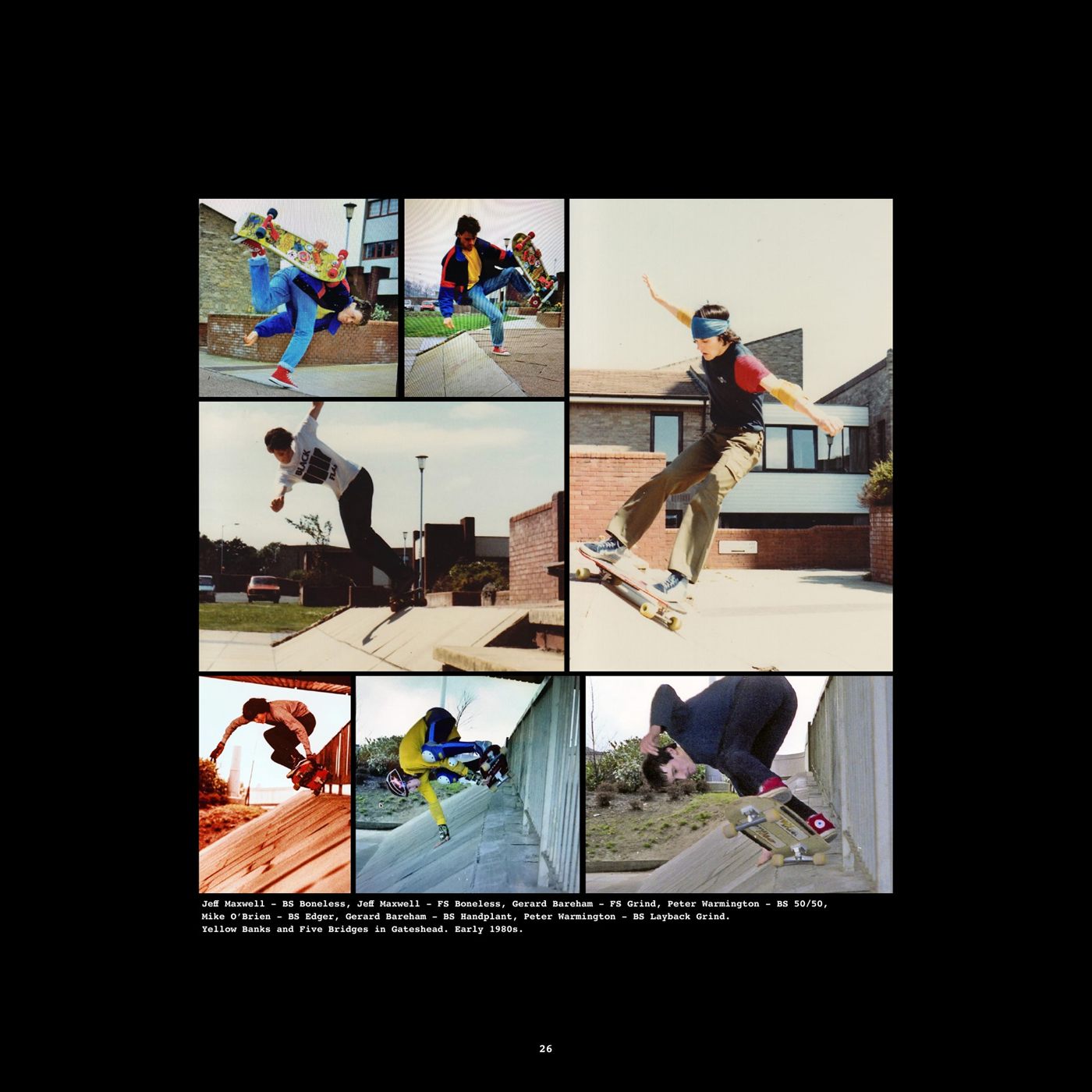
Figure 1.1a — Yellow Banks and Five Bridges, Gateshead, early 1980s. Riders pictured: Jeff Maxwell (BS Boneless, FS Boneless), Gerard Bareham (FS Grind, BS Handplant), Peter Warmington (BS 50/50, BS Layback Grind), Mike O'Brien (BS Edger). Reproduced from TBK, p. 26 (© Shred The North & PlayToon, 2023).
Through the following four decades the site remained the region's de-facto wet-weather refuge for skaters with no covered alternative. Matt Potts, writing in the same volume about the early-1990s Newcastle scene:
"We'd skate at the Monument, Newcastle University, Newcastle Polytechnic and Civic Centre. When it was raining, we'd head to 5 Bridges in Gateshead…"
— Matt Potts, TBK, p. 46
By the late-2000s and 2010s, after the plaza build, the site became the regular venue for community-organised events — the Digital Deekies-era King of the How Man jams, S.K.A.T.E. competitions, and birthday sessions documented through that decade (Thirtle, TBK, p. 93). From the founding of Shred The North in 2014, 5 Bridges sits in the published record of the CIC's programmed events alongside the Wastey and the Moon DIYs:
"It's been the primary motivator for ad hoc events at a number of North East skate spots (river 5 on the quayside, 5 Bridges in Gateshead, a few at both the Moon and the Wastey diys and many more) since 2014."
— Dave Apomah (Shred The North), TBK, p. 107
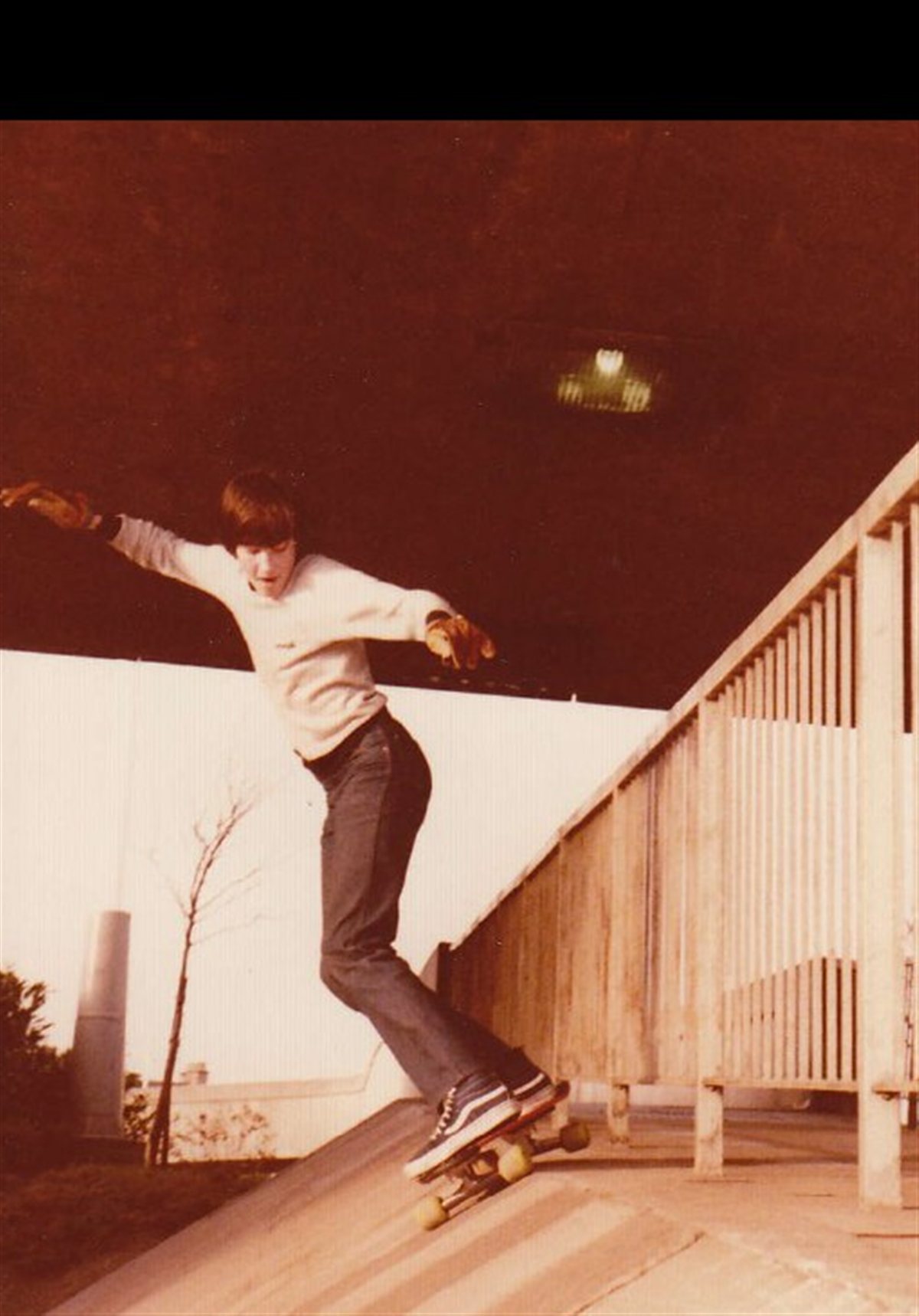
Figure 1.1b — Mike O'Brien (TBK, p. 12, © Shred The North & PlayToon, 2023).
The implication for the policy case below is direct: replacement is not the creation of new provision but the restoration of provision the site's own geometry has supported, in continuous skating use, for over forty-five years. The 2025 loss interrupted a four-decade-plus through-line, not an eighteen-year one.
It drew skaters from across the region and beyond, and developed an international reputation as a plaza and street-skating destination. The footage filmed there — in magazines, videos, and online — put Gateshead on the global skateboarding map in a way few council-owned facilities ever achieve. The pattern of international-pro engagement with the wider Gateshead scene extends back into the bank-skating era too: TBK records that brick-transitioned planters in Gateshead were "famously skated by Lance Mountain decades later" (TBK, p. 33), one of several US pros the North East drew to the region during the 1980s and 1990s.
Industry voices echo this assessment. In the concept design report developed for the replacement project, Betongpark described 5 Bridges as an “internationally recognised” skatepark whose “unique undercover setting beneath the flyover” made it a “year-round destination for skaters of all ages and abilities” that “played a major role in the identity and energy of Gateshead's skate scene” (Betongpark, 2026-05-16, p. 2).
View this post on Instagram
Figure 1.1d — 5 Bridges in the media: community coverage on Instagram.
1.2 Impact of Closure
When 5 Bridges closed in 2025, the region lost more than a skatepark. It lost:
The effects of the loss are visible: dispersal to parks that don't fit the terrain people skate, a measurable drop in winter and wet-weather use across the remaining provision, and a gap in the borough's youth, leisure, and cultural offer that this Options Study is the council's first formal response to.
1.3 Policy Alignment
A replacement covered facility, delivered at a suitable site, is not a marginal call against Gateshead's policy framework — it is a direct response to commitments the council has already made. The closure of 5 Bridges in 2025 created an unresolved gap inside every adopted strategy that names recreation, youth amenity, placemaking, or active environments. Each document below identifies the kind of provision that 5 Bridges was, and that its replacement can be again.
| Policy | Evidence | Response |
|---|---|---|
| CSUCP CS14.1.v Promote access for all to play & recreation opportunities | § 2.4 survey: 134 responses; no covered alternative in the region post-2025 | Free, year-round, all-ages covered facility |
| CSUCP QB2 Quays allocated for D2 leisure use as a principal use | Original 5 Bridges site sits within QB2 boundary; A184 underside is underused infrastructure | Replacement reuses framework-allocated land |
| MSGP39 Loss of recreation provision only acceptable if replaced by equivalent or better | 2025 closure; no equivalent provision exists | Replacement is the policy-anticipated route |
| PAS Objective 5 Make it easier to be active in the space around them | 56% of users travelled 5+ miles; alternatives in Leeds / Glasgow are unaffordable for many | Town-centre provision; no travel cost |
| CYP Strategy 2025–2030 Young people asked for safer inclusive social and leisure spaces | § 2.4.4 voices: "third place outside school and home" | Covered, supervised, community-built |
Figure 1.3a — Adopted policy commitments mapped to evidence gathered through the study and the proposed response.
Local Plan: placemaking, recreation, and the Urban Core
Gateshead's adopted Local Plan comprises the Core Strategy and Urban Core Plan (CSUCP) 2010–2030 (joint with Newcastle, adopted March 2015) and Making Spaces for Growing Places (MSGP) (adopted February 2021). A new joint Local Plan with Newcastle was launched in February 2025; the CSUCP and MSGP remain the operative development plan in the meantime.
Five adopted policies bear directly on the case:
A significant detail of the council's own policy cross-referencing: the prior Unitary Development Plan's "CFR30 Teenagers' Recreation Areas" designation maps directly to MSGP 39 and MSGP 40 in the current Plan. The council's own classification places teenage recreation areas under both the protective policy (MSGP39) and the provisional policy (MSGP40).
Gateshead Quays Development Framework
The site that hosted the original 5 Bridges sits inside the area governed by CSUCP Policy QB2 (Gateshead Quays Key Site). QB2 is unusually direct about what Gateshead Quays should deliver. It allocates the area for mixed-use development with principal uses including "Office (B1), Leisure and Conferencing Facilities (D1, D2), Hotel (C1), Residential (C3) with ancillary Retail (A1, A2, A3, A4) uses" — meaning that D2 leisure use, into which a skatepark falls, is one of the principal allocated uses, not an exception.
QB2 then specifies how that development will provide "cultural and commercial focus":
The CSUCP supporting text (§ 17.73) describes the public realm intent as "a variety of environments reflecting the nature of their context, suitable for a range of uses from major events to informal relaxation areas". A covered, free-at-point-of-use, all-ages skating facility on or near the original site would deliver D2 leisure use, public events space, and a destination on the town-centre-to-riverfront pedestrian route — in one move, at a fraction of the cost of any other intervention on that land.
The Council Leader's foreword to MSGP (Cllr Martin Gannon) singles out Gateshead Quays as a flagship next-decade regeneration commitment: "a new multi-million pound, state-of-the-art entertainment arena and conference and exhibition centre which will revitalise a key site on Gateshead Quays".
Physical Activity Strategy 2022–2032
The Gateshead Physical Activity Strategy 2022–2032 opens with a foreword that names the case for replacement provision in plain terms:
"For too long, many of the people with the most to gain from being physically active have often been the least able to take part. A combination of structural, social, environmental and economic factors have all played their part in keeping people away from physical activity, including access and affordability, a lack of opportunities, or a feeling for some that 'physical activity is not for them' or they 'don't belong' in sports facilities or clubs."
The strategy positions Gateshead as a Marmot City, "passionate about the need to build back fairer", and commits to ensuring that "every Gateshead resident can easily access a range of opportunities for sport and physical activity regardless of age, gender, race, ability, background, where they live or income". Skateboarding sits within the strategy's own definition of "active recreation", alongside walking, cycling, dance, and active play.
Three of the strategy's five Objectives apply directly:
The strategy's principle of "proportionate universalism — focusing most on engaging the least active and those who face the greatest barriers to being active" is a direct mandate for inclusive, free-at-point-of-use provision that does not require club membership, equipment hire, or skills the user is presumed to already have. That describes 5 Bridges as it operated.
Children and Young People's Partnership Strategy 2025–2030
The Children and Young People's Partnership Strategy was adopted by Cabinet in October 2025. Its Vision: "Make Gateshead a place where every child and young person has the building blocks to thrive and are supported to live fulfilled, safe, happy and healthy lives, with the education and skills to enable them to realise their potential".
The strategy commits to four outcomes — that children and young people are heard and have influence, are happy and healthy, feel safe in their families and communities, and achieve their potential and feel ready for their next steps.
The strategy was co-designed with input from over 100 young people across Gateshead's secondary schools, the Gateshead Youth Assembly, Children in Care groups, Young Ambassadors, the SEND Youth Forum, young carer groups, and a 93-respondent public consultation. The cabinet report records, verbatim, what young people themselves said matters to them. Five of the ten consultation themes are directly addressed by a 5 Bridges replacement:
- "Safer inclusive social and green spaces and leisure opportunities"
- "Feeling safe linked to a reduction in knife crime and ASB"
- "Emotional wellbeing and mental health"
- "Opportunities to develop life skills and better experiences of transition"
- "Being heard and having a voice"
The strategy's integrated impact assessment notes that the strategy is "likely to have a wide ranging and significant positive impact on the building blocks of health and wellbeing for children and young people", and that "the strategy aims to reduce crime and disorder involving children and young people through a range of prevention and early intervention work". Evidence from § 2 corroborates that 5 Bridges performed exactly this preventive role for many of its users.
Local context recorded in the cabinet report: around 40,000 children under 18 live in Gateshead, around 1 in 4 children live in poverty, and the number of children with an Education, Health and Care plan has grown 24% in the last three years and 37% in the last five years. Free, supervised-by-community, all-ages provision is the kind of intervention this strategy is built to enable.
Sport England — Uniting the Movement and place-based investment
National policy reinforces every Gateshead-specific commitment above. Sport England's Uniting the Movement 2021–2031 strategy sets out five "big issues", three of which apply directly: Connecting Communities, Positive Experiences for Children and Young People, and Active Environments ("creating and protecting the places and spaces that make it easier for people to be active"). The Gateshead Physical Activity Strategy's five Objectives are recognisably the same framework.
Sport England's place-based investment programme — up to £250 million of National Lottery and Exchequer funding into more than 90 places across England — is "unashamedly targeting our resources and efforts on communities that need the greatest levels of support and experience the greatest levels of inequality". Gateshead's Index of Multiple Deprivation profile, the documented loss of regional covered provision, and the § 2.4 survey evidence on regional draw and inequality of access place a 5 Bridges replacement squarely in Sport England's stated funding priority.
Across the four locally-adopted documents and the national strategy, the alignment is total rather than partial. The replacement is not asking the council to invent a new policy direction — it asks the council to deliver against the direction it has already set, on a site already allocated for the use the proposal would deliver, against a recreational gap the council's own protective policy says should not stand.
1.4 Study Brief & Methodology
This study was commissioned by Gateshead Council and is being delivered by Shred The North, a Community Interest Company with a decade of skateboarding-infrastructure and programme delivery across the North East.
Scope
The study was commissioned as an 8-week options study to answer:
- Can any existing skatepark in the borough adequately replace 5 Bridges?
- If not, what new sites are available, and which are best?
- What delivery options exist (scale, covering, phasing), and how do they compare?
- What site and approach does the evidence support?
Methodology
Four parallel workstreams run across the study period:
Outputs
The study produces a full written report to Gateshead Council with a recommended site, a recommended delivery approach, a phased cost plan, and a delivery timeline. The full report — including cost envelopes, funding strategies, and revenue projections — is in the § F Finance section, available to council and public alike.
The question this study answers is not "what would the perfect skatepark look like?" — it is "what is the best achievable replacement for 5 Bridges, on a realistic site, within a deliverable timeframe, that the council can act on?"